by Jon
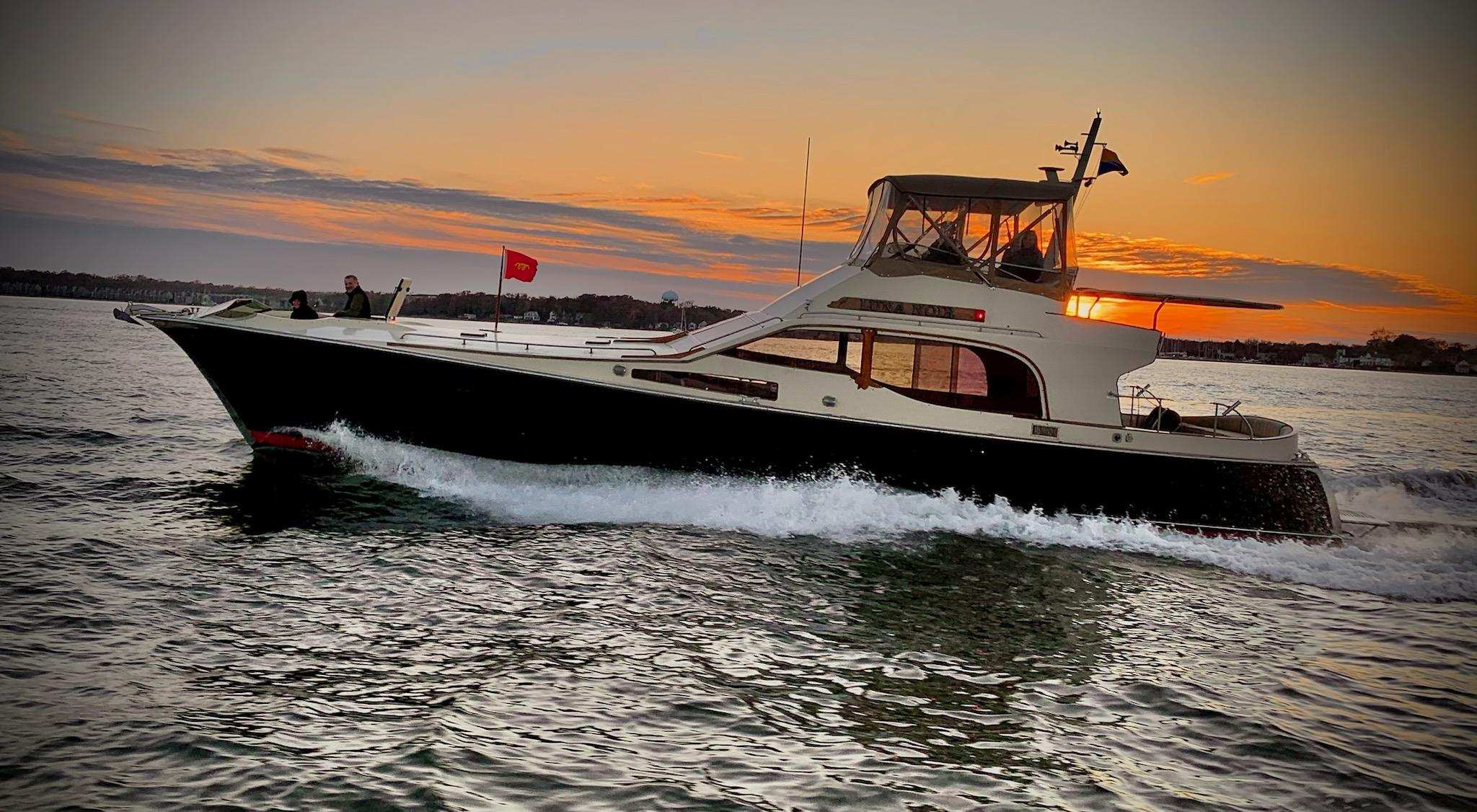
After four months at the Mega Dock in Charleston it was time to bring Eleanor home. Since bringing her south at Thanksgiving we hadn’t been able to visit Eleanor as much as we expected. Conflicts with work, family travel, and other commitments had clogged our schedules. We sadly had only one nice long weekend over New Year’s Eve to really enjoy Charleston, and not having even visited the boat in almost three months I used our little Cessna to fly down for the day two weeks ago with friends Mike Baldwin and Phil Buckley to deliver some parts and check her out for the six-hundred-mile voyage home.

In spite of sitting idle for many weeks, she was in good shape. No leaks. No visible problems. Just resting quietly waiting for us. After stowing the gear we brought down and finishing the few items on my work list I decided to fire up the engines. The port engine fired right up in less than two seconds and settled into her comforting calm rumble. The starboard engine turned over and cranked…and cranked…and cranked. I stopped trying. After a pause to rest the starter, I tried again. No joy. She wasn’t going to start, which was a new issue for me.
Diesel engines are pretty simple. To run they need clean fuel, clean air, rotation from the starter to build up compression, and BANG, the combustion in the cylinders gets things spinning and she runs. But this time starboard wasn’t going bang so what was missing? I opened the engine hatch and pulled out my little tool bag.
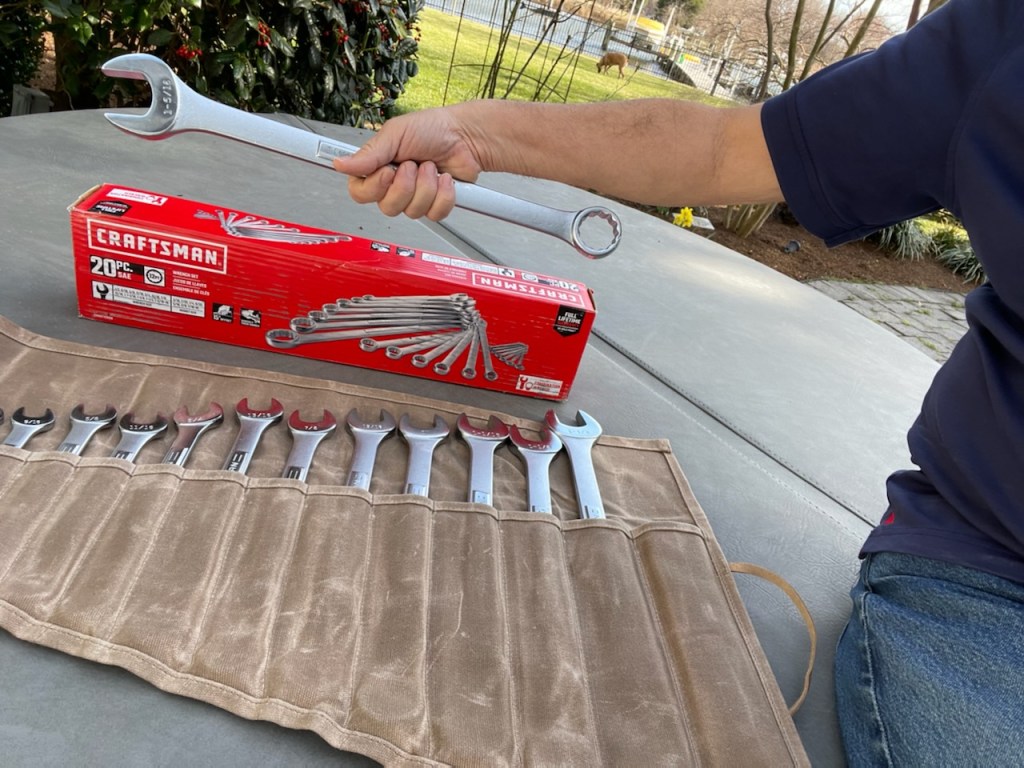
For my birthday I had asked Terese for a set of really big wrenches. Craftsman. 20 sizes all the way up to 1 5/15” and the entire set weighed in at over twelve pounds. The problem with having new tools is the desire to use them. Instead of starting with the obvious, I went right for the wrenches and started bleeding the fuel system. Loosening a bolt on the downstream side of the fuel filter I pushed on the pump and fuel trickled out, just as it should. Not the problem. I tightened everything back up and took two steps back. Go back to the basics, I thought. I climbed down into the engine compartment and went to the fuel manifold to check valve alignment. The starboard engine fuel valve was closed. Who the hell did that?
With the valve opened the starboard engine started right up. After warming both engines I decided to make sure the transmission worked. I put the engines into gear and back out one at a time. Mike and Phil were standing by the transom when I did it and yelled for me to look toward the stern. When the props spun, a huge layer of seaweed and oyster shells had flung off creating a dramatic mess. I wasn’t worried. I had a diver set to clean the bottom soon. Four months of sitting in the temperate South Carolina waters had overcome our tired bottom paint, but that wouldn’t slow us down for our cruise. After a failed search for shrimp and grits in town (note: don’t try to have lunch on a beautiful day in Charleston sans reservations) we climbed back into the Cessna and headed home.
Our crew for the voyage home, (Terese and our friends Kurt and Michelle) were set to fly in from Baltimore on Saturday the 26th, so I headed south a few days before to be sure everything was greased. I gave both engines a thorough going over, topping off fluids and lubricating moving parts. The incoming crew gave me an extensive grocery list and I did my best to fulfill all their requests at the Publix. I ran through a twenty-item pre-underway work list of minor tweaks and got us ready to get underway as soon as the crew hit the dock.
The forecast for our departure on Saturday was for wind. Lots of wind. It was going to start light out of the northwest, but with gusts doubling the velocity at times. Throughout the day it was going to keep rising with the forecast calling for 15-20 knots, with gusts to 31 by the afternoon. The sooner we could get underway the better.
While I waited for the crew, I set up our little pirate flag on the bow and noticed the prevailing winds were right down the narrow fairway where we were docked. The gusts came more from the south, which meant that when steady, it was straight on our bow which would help push us in the direction we needed to go to get out of here, but, and it was a big but, when a gust came it would push us to starboard, toward two boats moored directly astern of us. I did not want to find us bouncing off two million dollars-worth of yachts: a Flemming and a Hinckley.
The ideal time to get underway in Charleston is at slack water. The moment when the tide stops ebbing out, or flooding in, and there is no current in the basin. With tides going up and down more than five feet twice a day, there is a lot of water moving in and out of the river. We didn’t need to contend with current on top of wind. Slack water low, at the bottom of the tide cycle, would be at 10:04am, exactly the time the crew would be making their way from Charleston International. Getting off the dock smoothly depended largely on how quickly they could cab or Uber. When they texted that they were off the plane and on the road, I decided we’d try to make it.
I started singling up lines, taking off the extra moorings we’d put in place four our four-month wintering over, as I anxiously watched the pirate flag. The current had stopped moving but the wind was building. Ahead of us was a new 40-foot center console Intrepid, tender to a big yacht moored in the harbor. It’s triple 400 horsepower outboards gleamed at me. I was surrounded by opportunities to do millions of dollars in damages, along with the threat to our own Eleanor.
Finally, I saw the the crew walking briskly down the dock. Quick hellos aside they threw their luggage on board and went to work. Most of the lines came aboard quickly and with only a bow spring and stern line left, Kurt cast off the stern line to Michelle and climbed aboard.
I put the port engine ahead, kicking the stern out a little and moving forward away from the Flemming. Putting engines into and out of gear, I tried to twist the stern further out so we could back out.
But the wind wasn’t having it. It pushed the stern back in. Not enough power.
I goosed the throttle to twist harder and as the stern came out the bow went in. We were all wearing headsets so I was able to give Terese a quick request.
“Terese. I need you on the dock to hold the bow out.”
Terese hopped off the bow and dropped lightly onto the dock. She leaned hard into the bow and created a fulcrum point. I started another twist, port ahead, starboard back. The stern kicked out and Terese held the bow off the dock. I looked aft and it appeared we were getting far enough out to clear the Flemming. I goosed it a little more to give myself more clearance.
“Terese, back on board.”
She grabbed the rail and threw one leg on the boat, the other still dangling as she gave one last push off the dock before clambering back on board. With Terese safe, I put both engines astern and started backing out.
But that damn wind started a big gust, pushing us sideways toward the Flemming as fast as we were going backwards. Our starboard side was sliding right into the corner of her transom.
I revved the starboard engine to near full power and we started moving backwards faster, but now the bow swung toward the Flemming. I slowed the starboard and revved the port hard, the acceleration backwards increasing but now pulling the bow to port. With a lot of noise from our high revving engines we held the attention of everybody in the marina as we slid past the Flemming with at least a foot to spare.
We backed out of the fairway, stowed our fenders and dock lines and headed out for our first day northbound. The crew survived this first adventure with grace (Terese), competency (Kurt & Michelle), and luck (Jon).
 Aboard Eleanor
Leave a comment