-
Racing the Wind
-Jon
After breakfast and a quick trip to the town dock for a pump out we pointed Eleanor’s bow out through the Belhaven breakwater and back to the ICW, our destination for the day – Norfolk.
The benign weather forecast was worsening by the hour with strong near-gale force winds now predicted for Thursday. We needed to get 150 miles north to Norfolk by Tuesday so we had Wednesday to run up the Chesapeake. If we got delayed the window was going to shut, leaving us stuck 150 miles from home for at least three days.
We had several challenges ahead as we cruised up the Pongo River towards the 22-mile-long Alligator-Pungo Canal. The first challenge was going to be the swing bridge on the Alligator River. Fully exposed to the weather at the junction of the river with the broad Albemarle Sound meant that this was one of the only bridges that wouldn’t open in strong winds. As we rounded the corner at the south end of the Alligator and started heading straight into the wind and waves I could tell we’d be okay but not by much. Gusts were hitting the mid-twenties but the limit is 34 knots. We motored on up and the bridge tender kindly opened for us.

Pelican Observers Once through the swing bridge, the base populated by a huge flock of pelicans who decided it was too windy to fly, we made our way into Albemarle Sound. This is possibly the most weather restricted stretch of the Intracoastal. Combining distant low shorelines unable to block the wind with a very shallow depth, any storm stirred up a steep wave pattern that made it unpleasant, even dangerous, to cross. We worked our way across, taking solid waves over the bow. Eleanor has a comfortable motion in a seaway, sashaying her way through the swells, not fighting the waves with an abrupt pounding like many powerboats. It was still the roughest section of the trip.
Back in the ditch of the ICW we now had to calculate time and distance to get through a series of draw bridges and a lock to our destination for the day at the north end of Norfolk harbor. The densely populated area south of Norfolk and Virginia Beach has a number of bridges that cross the ICW. For the last three decades, all new ones are built to a fixed height of 65 feet, which meant they would be no factor for us, or the commuters driving across. Unfortunately, there are still draw bridges and to facilitate road traffic, they limit openings to either once an hour or every 30 minutes depending on their posted rules. It became imperative that we hit the first bridge with an opening on the hour at exactly 2:00 pm. That gave us 30 minutes to go five miles to the next bridge opening at 2:30, followed by a 3.5 mile run to the Great Bridge lock at 3:00 pm. If we made the first bridge on time, we could make it to the Norfolk Yacht & Country Club by 4:00, before the Dockmaster left for the day. If we missed the first bridge opening by even five minutes, we would be set back an entire hour. We cruised slowly through the world-famous town of Coinjock and kicked Eleanor back up on plane to get to our bridge opening.
Everything went as planned and we made it through all the drawbridges and into the Great Bridge Lock at 3:00. The lock is unusual in that unlike most locks, it isn’t to move vessels up or down in water level. The purpose is to keep the salt water from the Atlantic Ocean, Chesapeake Bay, and the Elizabeth River from Norfolk from contaminating the fresh water Currituck Sound of North Carolina. Plants and animals prefer either fresh or salt water environments so this “guard lock” is needed to impede water flow through the man-made canal connecting the two different ecological systems.
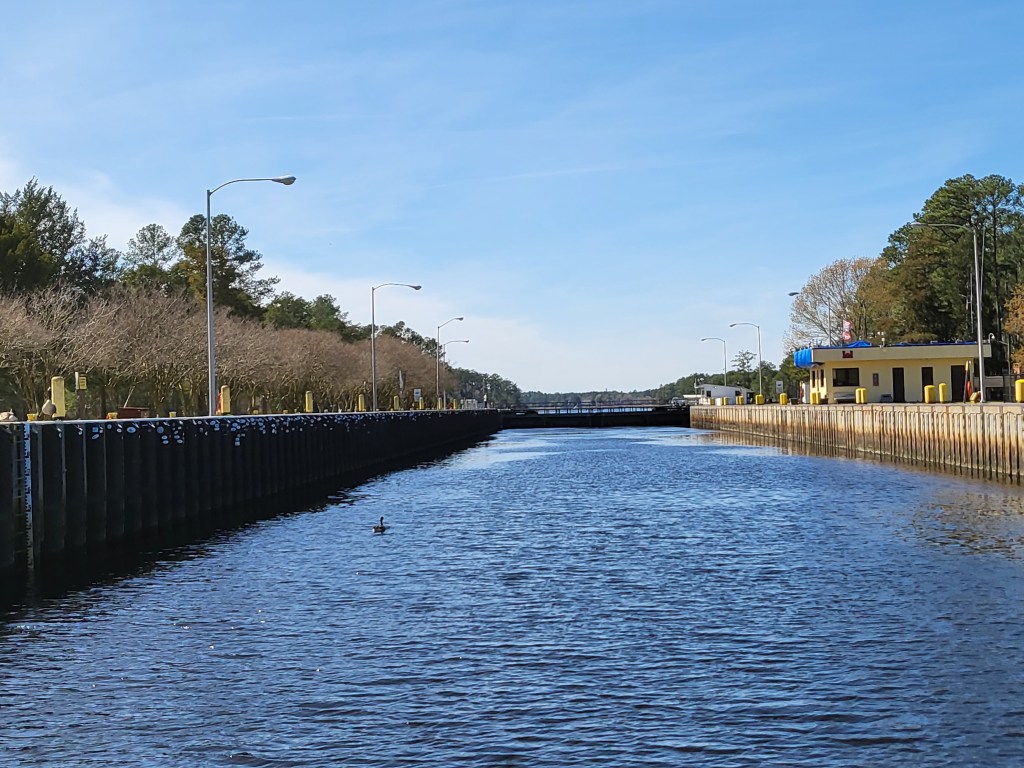
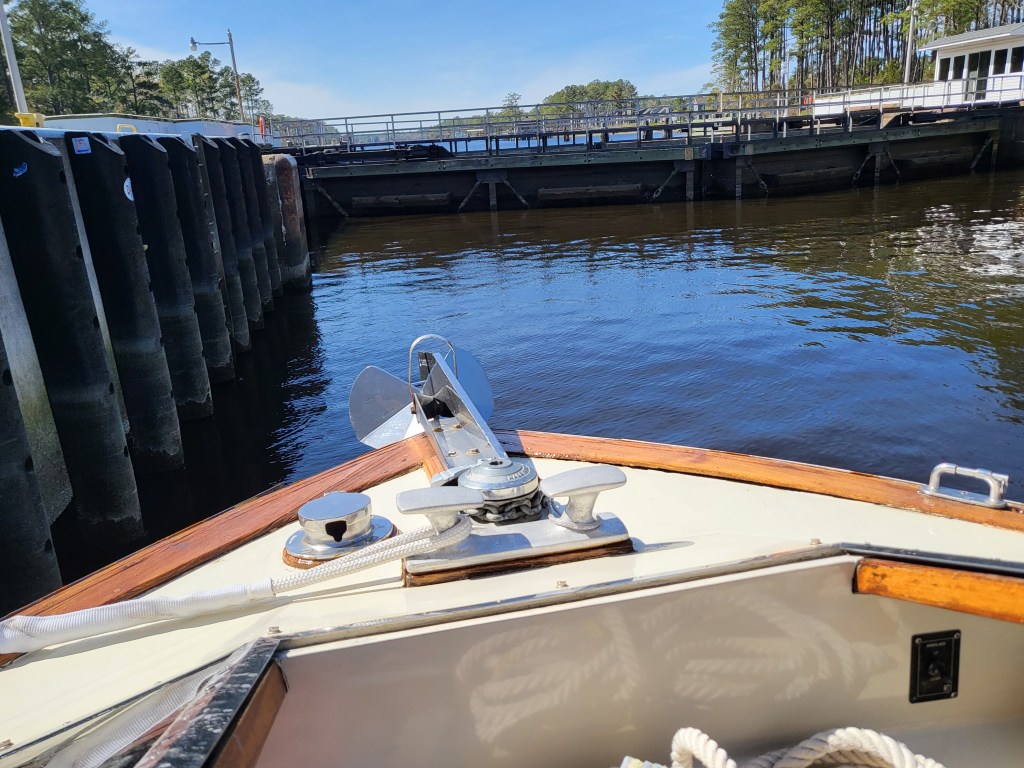
Eleanor snugging up in the Great Bridge Lock Locking through took 20 minutes, then with speed zones through the southern reaches of Norfolk Harbor slowing the pace, we finally arrived at our destination at 4:45. The dockmaster had left for the day, but as it turned out, it didn’t matter. This early in the season we were the sole transient, so we had our pick of berths for the night. After a little exercise in the fitness center, we had a pleasant dinner in the yacht club overlooking the container ship terminal in the harbor.

Norfolk Terminal at night -
The Sound of Silence
-Jon, March 30, o’dark-thirty
I laid in my bunk, enjoying the complete and total silence at 1:30 am here in Eastern North Carolina. The wind from the afternoon, which had been gusting to 30 knots and slamming whitecaps into Eleanor’s port side here in the marina at Belhaven all evening, had finally died down to nothing. I could stop worrying about my Rube Goldberg spider web of lines holding fenders in place to protect our beautiful boat. I didn’t know what had woken me up, but I enjoyed the stillness.
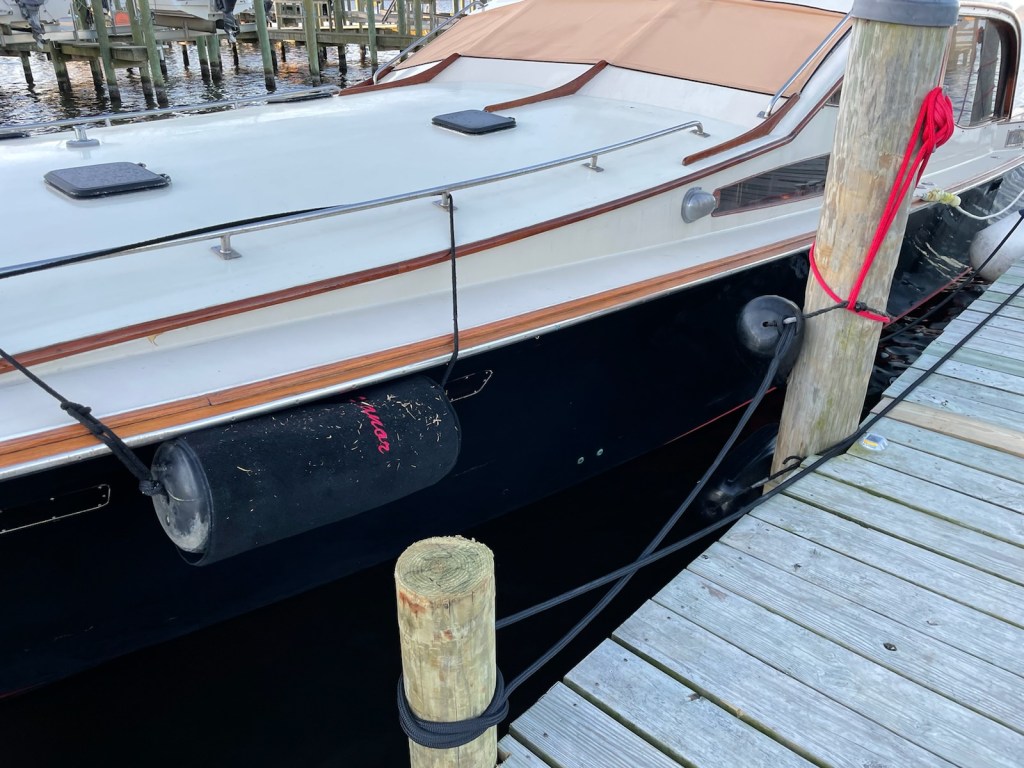
The line Rubik is actually quite scientific Wait! It’s going down to freezing tonight. How could it be so quiet right now? I’m not hearing the heating system. No blowing warm air. No generator. NO Generator!!!
When we tied up to the dock at 3:00 in the afternoon we had been challenged by the wind. Made it in fine but unfortunately found out after the fact that the single 50-amp power outlet we could reach with our fifty-foot cord was broken and only delivering 105 volts on one leg (to the surprise of the marina manager.) Only planning to be here overnight, and not wanting to try and move the boat in the wind I decided we would just stay on ship’s power. Our trusty Kohler 8-KW generator would keep the lights and heat on for us. No problem.
No problem, at least until there is a problem. Eleanor had gone cold and dark. No power. No heat. No gentle reassuring sounds that all was well. She was just completely still.
I lay in bed, considering my options. I was currently warm and comforted by the 16-pound Thunder Blanket that Terese had bought for Eleanor’s forward bunks. I wondered how cold it would get in the cabin. Could I wait until morning to try and figure this one out? What could be the problem that caused the generator to shut down? I wondered if it will fix itself.
With that last thought I realized I was being stupid and needed to get up and see if I could fix the generator. I suited up and creeping stealthily through the boat to avoid waking the rest of the crew I gathered my tool bag, a flashlight, and made my way outside into the frigid air.
The generator resides in the Lazarette, a compartment at the very back of the boat, under the bench at the aft end of the cockpit. I turned on the LED lights I’d installed inside as part of my rehab project, and the space lit up like noon on a summer day, the light reflecting off the bright white bulkheads that I’d painted last summer. I climbed down into the space to see if I could figure out why the generator had shut down.
My first thought had been maybe an automatic shutdown alarm for something like a low oil level. That would not have been ideal, as it would mean the generator was burning oil, but it would certainly be an easy fix. It also seemed possible – even likely – back when I had been laying snuggly under my thunder-blanket considering the possibilities. I hadn’t checked the generator oil level since Charleston, and we’d run close to 30 hours since then. (I know it’s bad not to have checked the generator out in three days, but I had my excuses.)
A quick check on the dipstick. Oil at the same level as the last time I checked. A happy sad experience. The easy fix for tonight’s problem wasn’t it, but the long term health of the generator was great.
Diesels don’t need much, as I’ve already said. I checked the fuel filter. It’s a new one, with a transparent sight bowl so you can see the quality of the fuel going into the generator’s engine – a three-cylinder Yanmar diesel. The quality was fine – nice clear pink color, no traces of water, algae, or sediment. But the bowl was almost empty. No fuel. I found my problem, but not the cause. Why no fuel?
I started tracing the fuel lines back toward the tank. Back here in the lazarette there were no valves. Those were up forward in the engine room. Nobody had been in there overnight, so I knew valve alignment hadn’t changed and the generator had obviously been running with the existing valve alignment so nothing there to check. I wondered if the fuel pump had failed. If so, we were going to remain cold and dark as I don’t carry a spare onboard. I decided to keep checking other things before assuming anything about the pump.
One benefit to buying a project boat during the Covid pandemic is I’ve had lots of time to work on pretty much every system onboard. One of my repairs/learning experiences had been to replace the secondary fuel filter system on the generator – twice. The first time I had removed the fuel filter to rectify a repair from some previous owner. It ended up being unrepairable and so after a brief course on YouTube University and a six-minute training video, and with a purchase from a diesel parts supplier on the internet, I had installed a brand-new fuel filter system including bleed valves.
Air in a diesel fuel system is bad. The fuel can’t push past the air and the engine shuts down. And that is exactly what our problem turned out to be. Quickly bleeding the air from the system from three different points, the generator fired back up, and as I write this, she is still running strong, heating the boat and brewing us coffee five hours later. Hopefully we are all set, and she just sucked in some air during all the bouncing alongside the dock in the wind.
Time to go in search of biscuits and gravy in Belhaven before we head north.

Ginger’s menu 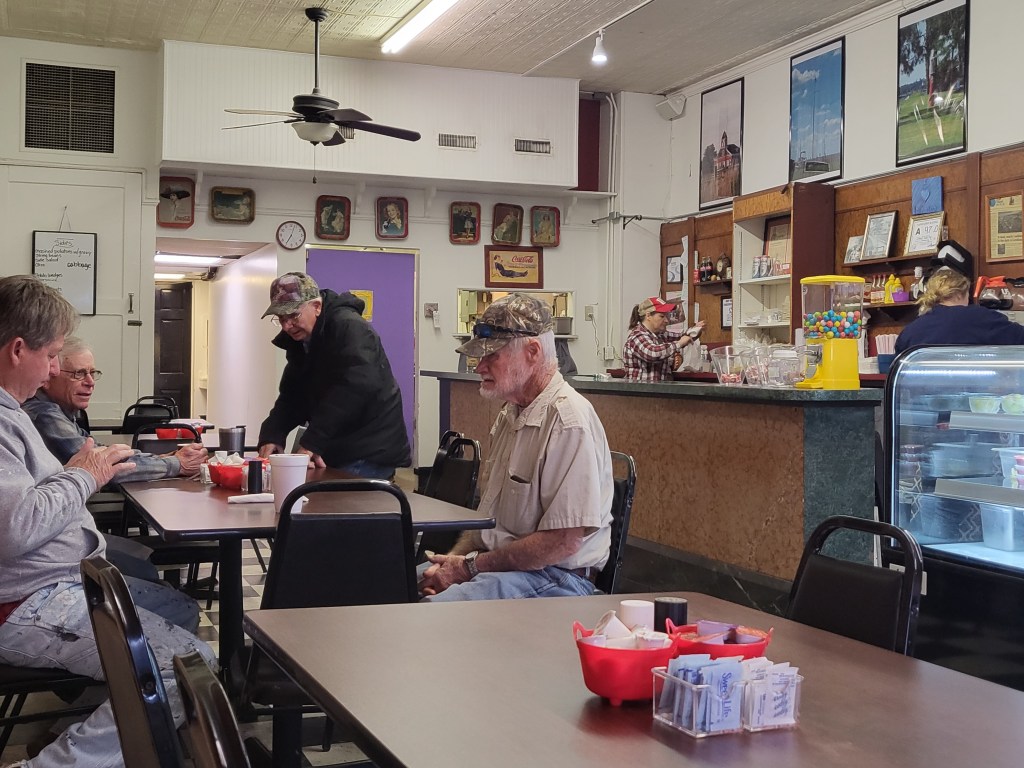
Ginger’s Men -
Mayberry Has Evacuated
-Terese, March 29
But Andy Taylor is still here.
Belhaven, North Carolina can only be mistaken for that semi-fictional town where sheriff Andy Taylor kept all things, always politely, under control. Brad, the owner of the Belhaven Marina is the place’s Andy. He greeted me as I wandered up the dock into the yard, where there is a gazebo with individual hammock chairs, and furniture arranged for a quaint social gathering – perhaps Aunt Bee’s bridge club. A small putting green is situated just outside the office/store, where you can “bundle” a t-shirt, a beer, and shot all for $18.00. A volleyball net waves in the breeze over a makeshift sandy beach, right next to a mini basketball half-court. Vintage photos of young men sporting navy uniforms, holding their gals, make for a pin-up effect in one of the bath houses. Titles from the lending library poke out from boat-shaped shelves just outside the showers.
“Oh, you gotta try ‘Spoon River’ – it’s been said to be the best restaurant between Maine and Miami on the ICW,” Brad tells me. There’s also a steak house, the Farm Boys grill, a new Mexican place, and a tavern. We are at first thrilled at the prospects, only to learn that on Mondays, everything is closed. Spoon River’s breezy, sensual yet comfortable décor teased us from behind broad windows. Several boutiques beckoned, even with cheery invites in curly-cue handwriting on chalk sidewalk boards. But Michelle and I could only smush our faces against panes of glass fomenting at chic artisan wearables. When Mayberry shuts down, it shuts down hard.

Wistful window shopping Spoon River’s owners, Teresa and Mark Von Staalduinen have apparently been bestowed with development grants, which they plan to invest in three more spiff-ups. Worn edifices will be rehabilitated in the way that we now stress blue jeans—they’ll be made new to look old – or to fit the Mayberry theme.

Cute boutiques teasing us with welcoming store fronts 
Storefronts under rehab The Mayberry of 2022 doesn’t throw you back so far as to be inconvenient. The eclectic and comprehensive ACE Hardware can accommodate any practical or impractical need. I know this because it’s where you must purchase a token to activate the marine self-serve pump-out station. As a woman who is excited at the notion that her hometown ACE sells women’s sized gardening gloves, you can imagine my delirium when I discovered a whole women’s department featuring blousy, gauzy tops and t-shirts, arranged by color and size. There were even some of those crafty wire and slate and mineral-type earrings and beaded necklaces expertly displayed on delicate hooks—a fine femme distraction from the paint aisle.
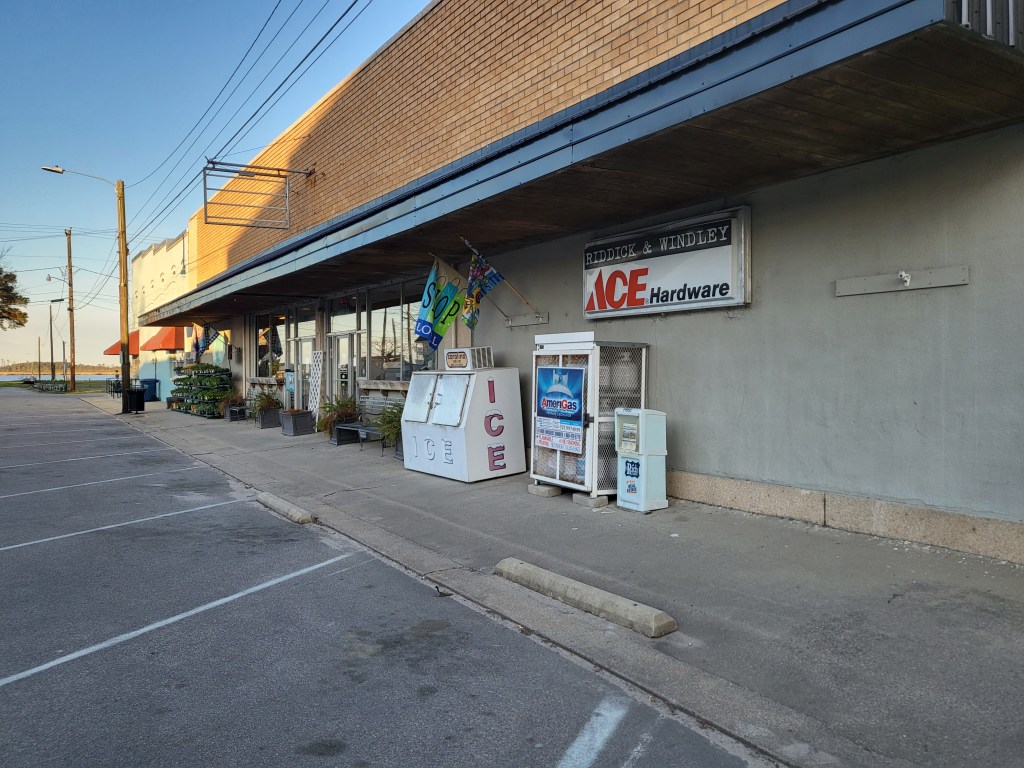
Women’s’ apparel department to the left… Not to let the Monday blues get us down, the marina GM, Gregg, (the opposite of Barney Fife) provided chauffer services in his sleek black, 2008 Jaguar, to Vinny’s, the local pizza joint, then took the long route home so we could cast admiring glances at the River Forest Manor, built in 1899 by John Aaron Wilkinson, a lumber yard president and vice president of Norfolk and Southern Railroad, overlooking the Pungo River. Gregg is former Navy, a gas turbine systems electrician, which my former Navy husband explained is a job performed only by the really smart guys. He’s so smart he left the Navy, then left his civilian job and bought the Belhaven Marina with Brad.
“We get maybe 50 boats in March. In April we’ll see 250,” Brad told me. “We’ll get 2,500 boats through here in the summer.”
Tuesday morning brought the early opening of Gingerville Bakery, which Brad says is owned and operated by an 82-year-old woman named…wait for it…Ginger. We ordered three dollar and fifty cent steak and egg sandwiches, omelets, and hash browns, and were romanced by the biscuits as well as the locals, who clearly each had a permanent, assigned-by-time seat at the middle table, where they could shout out greetings and wise cracks to townspeople who had less time to loiter.
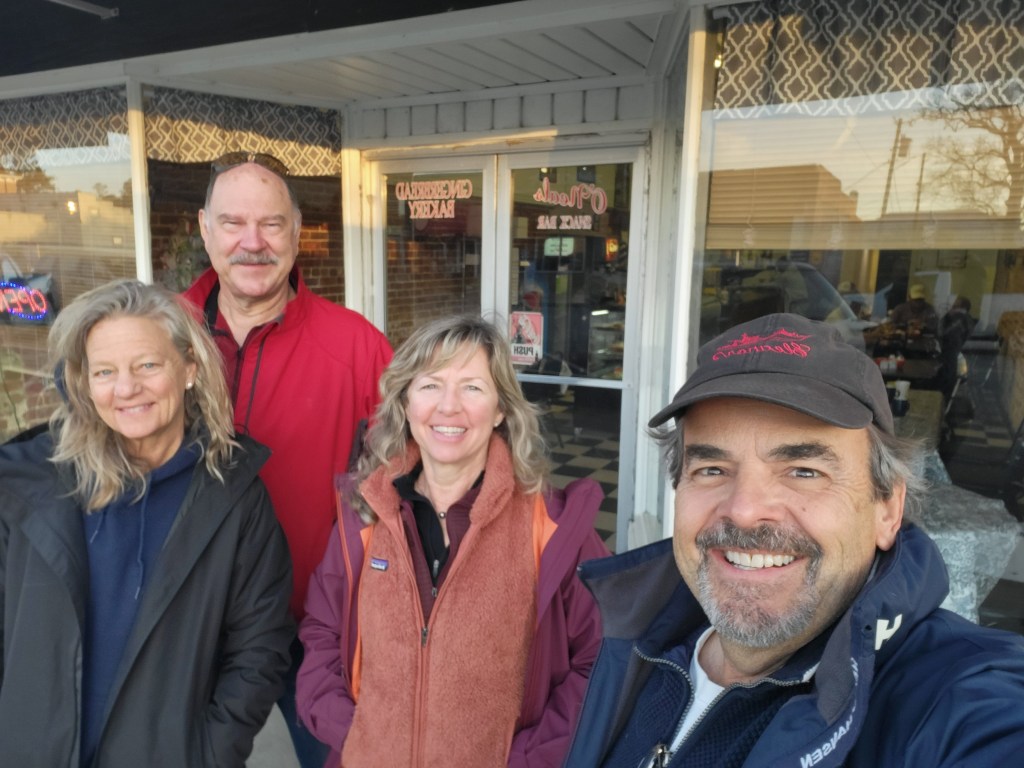
Bakery, but no sign of Ginger Bellies full, we toddled back aboard Eleanor, started the engines then cruised to another dock to use our token. Despite it being a self-serve operation, Gregg showed up to serve anyway, then wave us off as we pointed Eleanor’s bow north. With Mayberry to our stern we set our sights on the iron grey clad banks of the heavily armored city of Norfolk, ready for a quickening pace, or as brisk as it gets out here on the ICW.
-
400 Miles to Home and the Forecast Just Changed.
From Jon. Monday. March 28th, 2022
Monday morning before dawn we were sitting at the dock in Wrightsville Beach, just south of the drawbridge drinking coffee when I glanced at an email on my phone from the Chesapeake Yacht Club. The temps in Maryland tonight were dropping down into the 20’s so they were turning off the water to our dock, but hoped to have it back up by Thursday, depending on the gale force winds heading their way.
Gale force winds? Where did this come from. For the past week the forecast for the duration of our cruise had been for a large high pressure to park itself over the East Coast, giving us light winds, no waves, and comfortable temps in the 50s and 60s. Now we were looking at a closing weather window. Our old forecast was still reasonably valid through Wednesday evening, but Thursday was going to be a mess. Friday no better. We needed to get heading north, and quickly.
I pulled open my Waterway Guide to the page with bridges to see what the story was with the drawbridge 200 yards to the north. Bridges down here in the Carolinas come in three varieties. Fixed bridges with 65 foot clearance, and hence no factor. Draw or Swing bridges that open whenever requested, so only minimal delay to us cruisers. The third variety were draw or swing bridges in densely populated areas that only open at restricted times so they don’t create annoying traffic congestion for the cars trying to cross that particular bridge. I checked the guide and the Wrightsville Beach bridge only opens on the hour from 7 am to 7 pm. I looked at my watch. 6:50 am. Yikes!
“Hey everybody, bridge opens in ten minutes and then will stay closed for an hour. We are getting underway. Kurt, can you disconnect shore power. Terese, and Michelle start pulling fenders and lines, leaving bow, stern and the red spring line.”
I climbed up to the flybridge and started the engines to get them warmed up. Back down in the main saloon I started the generator and helped Kurt shift from shore to ship’s power. Terese got everybody headsetted up so we could all communicate and in less than five minutes we were ready for underway, with just the minimal dock lines holding us in position on the pier. It is a joy having a great crew who knew their jobs and jumped to them quickly and efficiently.
Looking south down the ICW we saw other boats pull off the dock, getting ready for the opening. We waited patiently and as the bridge opened and two sailboats headed past us we spun off the dock and got in line, heading north.
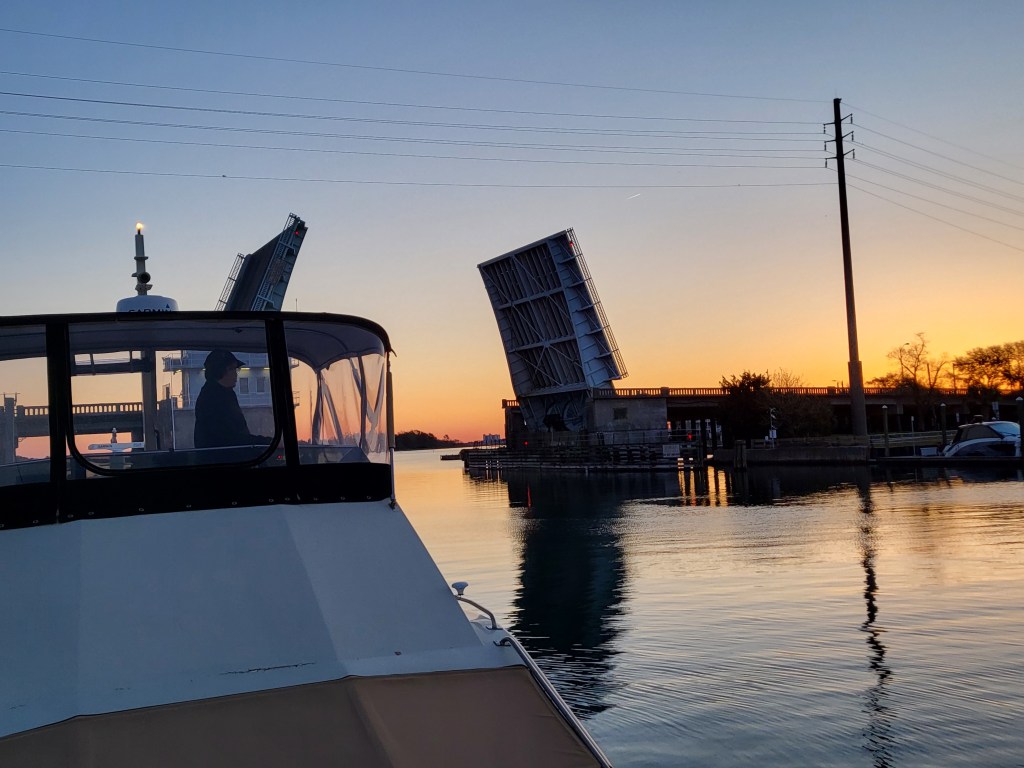
Just clearing the 7:00am bridge opening With the first obstacle out of the way we came up with a new plan for getting home. 150 miles up the ICW was the quaint little village of Belhaven. That was our goal for Today. Tuesday we would run another 150 miles up to Norfolk, which would just leave the Chesapeake Bay for Wednesday. The forecast for the Bay was 12, gusting to the low 20’s but from the south. The proverbial fair winds and following seas. It would be a gentle sleigh ride up the bay…if the forecast held. Thursday was forecast to hit forty knot winds, with the accompanying waves.
After going through the bridge, we did a slow pass of the two sailboats, kicked Eleanor up on plane, and started eating up the miles of the ICW at our customary 20 knots.
-
Arrivals
-Terese
Point B always surprises me. It sneaks up. I’m all in my rhythm of driving or staring at the paper chart, trying to make sense of all the lines and numbers and Jon says, “We’re almost there.” And I look at the chart again and I look at my watch and somehow a whole eight hours have passed, and we are indeed now searching for a specific dot on the map that the kind dockmaster had, after three repetitions over the phone, finally conveyed into my Yankee brain, would be Eleanor’s resting spot for the night.
“You wouh puup right t the guyass douk.”
“I’m sorry…?”
“Just spin’ bow t sou then we kin guyasserup.”
I’m trying to interpret. I look at Jon.
“Ma’am.” Speaking very slowly now because he knows I don’t understand but he can’t figure out if it’s because I am a northerner or if it’s because I am a woman.
“Jess pool.the. boat. right. up. to. the. guyass dock.”
“Will do!”
I turn to Jon, victorious.
“They’re putting us at the gas dock.”
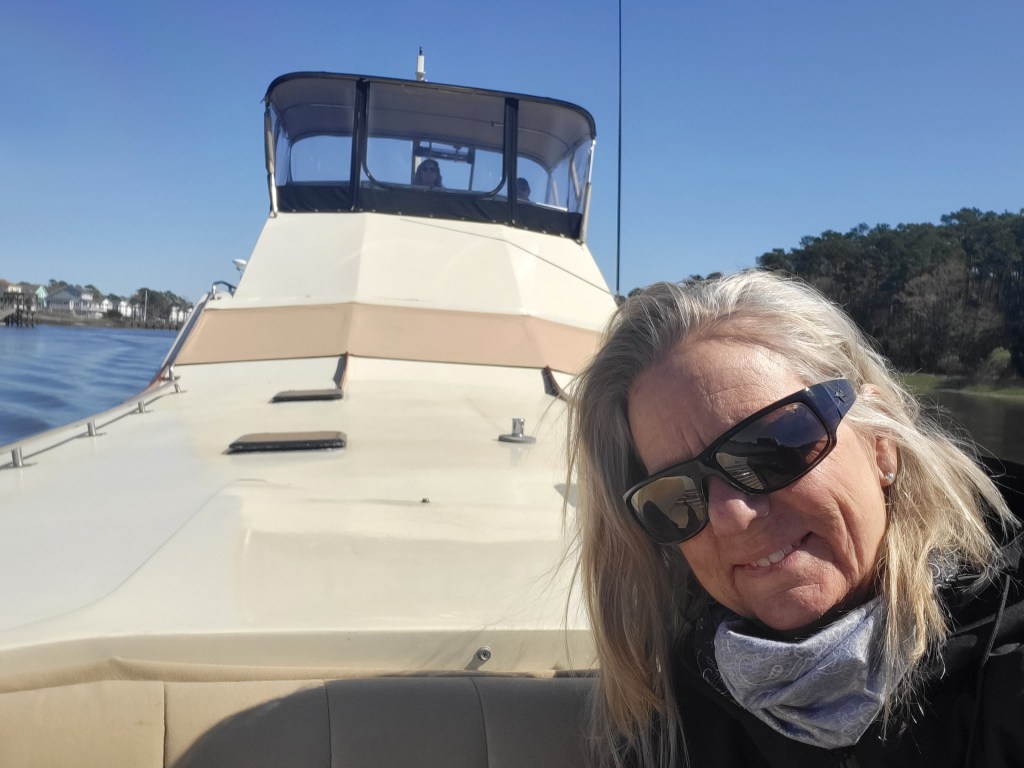
Jon gauges the wind and the current and slides Eleanor perfectly into place at the Wrightsville, North Carolina Dockside Marina and restaurant. We’ve made such good time that there’s plenty left over for a scrub. Not me, Eleanor. She’d not had a bath all winter.
I filled a bucket with soap and water, found a brush and went to town. It was somehow cathartic, symbolic of shaking off winter, stripping a layer so she could more deeply absorb the sun. I refused offers of help from both Michelle and Jon, happily sliding the suds around Eleanor’s decks, gently dabbing at my precious coats of varnish and coaxing the latest layer of salt back into the sea. We were united again: my elbow grease and her easy sway, both of us brightening at the thought of another summer of scraping, shellacking, chasing sail races and cocktails, her, holding happy guests from bow to stern, me, slinging drinks and snacks. It was good to be headed north.
-
East Carolina Hospitality
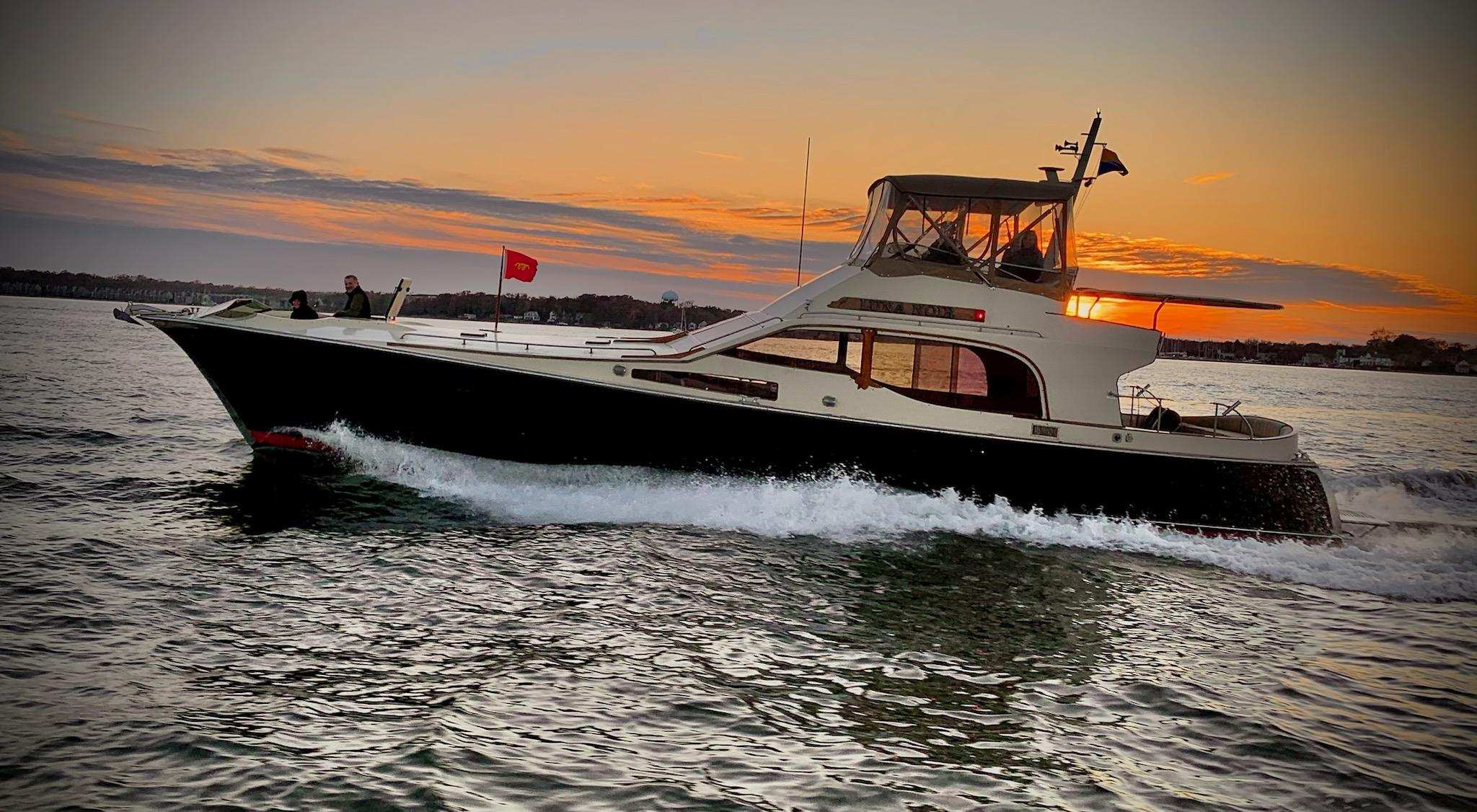
Like the prettiest belle at the ball, Eleanor cuts through the water with confidence, grace and a certain style that causes eyes to turn and then linger. Eleanor moves forward, sure of where she is going. The onlookers wonder where that is and wish they were going too, because it is sure to be a good place. She is only about good places, and the good place she is right now is cutting through beautiful rivers and canals in the Eastern Carolinas.
People everywhere are hospitable, but hospitality in the Eastern Carolinas is in their bones. Which is why Eleanor feels right at home here, as she is all about hospitality. Michelle and I were blessed to join Jon and Terese, the incredibly hospitable current caretakers of Eleanor (does anyone ever really “own” a yacht? True yachts are creatures that are spawned in the mind of an artist, brought to life by skilled craftsmen, and then wander the earth’s waters as they wish) as they journeyed north back from Eleanor’s winter holiday in Charleston.

Passages are a treasured time. Bringing Eleanor’s dear soul back from her relatively brief time swooning in Charleston’s rich atmosphere is an opportunity to disconnect from all those things that occupy and nag the mind most days, while one sets about with a singular purpose of getting from point A to point B. During a passage, the experiences in point A are imprints of fond memories that help build the anticipation of new memories to come at Point B. Being asked to help make the passage is a gift, and Michelle and I jumped at the chance given to us by Jon and Terese, although we knew we would not fully be able to shed the nagging everyday work routine completely.
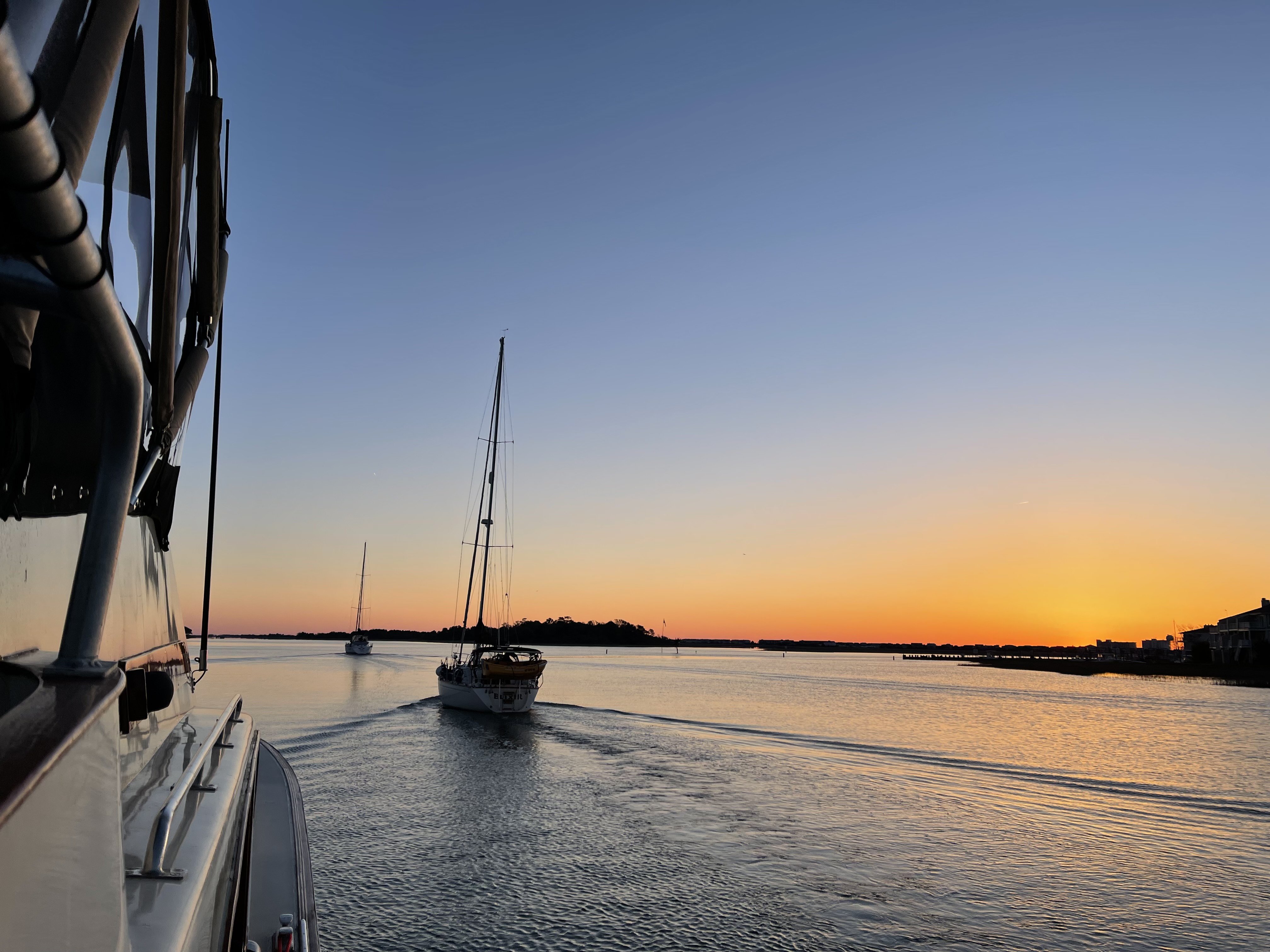
Leaving Charleston within 5 minutes of our arrival jumpstarted our focus, however, on the importance of getting to Point B. Our first goal was “somewhere around 60 miles north of Charleston on the ICW”, which as it turned out, was Georgetown. Many states, of course, have a Georgetown – the obvious namesake being the “father of our country”, and given the history of this Georgetown, in the hospitable coast of North Carolina, that was no doubt an influence, as Mr. Washington did actually sleep there, as memorialized on at least one plaque. However, there is so much more going on in this Georgetown than history. Once Eleanor was properly tended to, and fed with fuel and water and ice, our explorations lead us to a wonderful local craft gallery with many clever creations, several of which we took possession of after a pleasant exchange of conversation and cash.
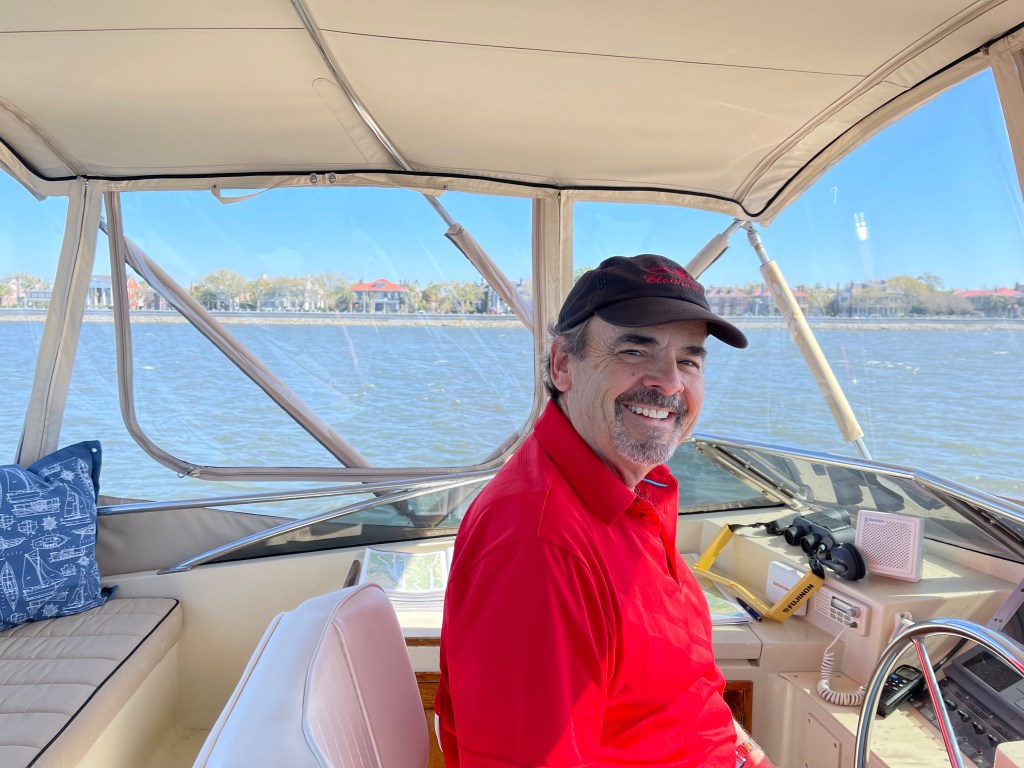
From there we ventured further into town, and found really good restaurants. Not just one or two, but several. And several places where one could just get a beer or something harder, in a very comfortable setting. Choosing where to make our “point B” memories that night was challenging, which gave us time to reflect together on what we truly enjoyed. One thing we all truly enjoyed was the cat cafe, which sadly, was closed for the day, but which still brought joy as we watched several obviously content cats lounging in the still sun-lit window, while one of their cat colleagues furiously exercised the large hamster wheel lined inside with cheetah spotted fabric. Clearly an over-achiever, that cat must have put in 5 miles of jogging while we waited for our dinner reservation across the street.
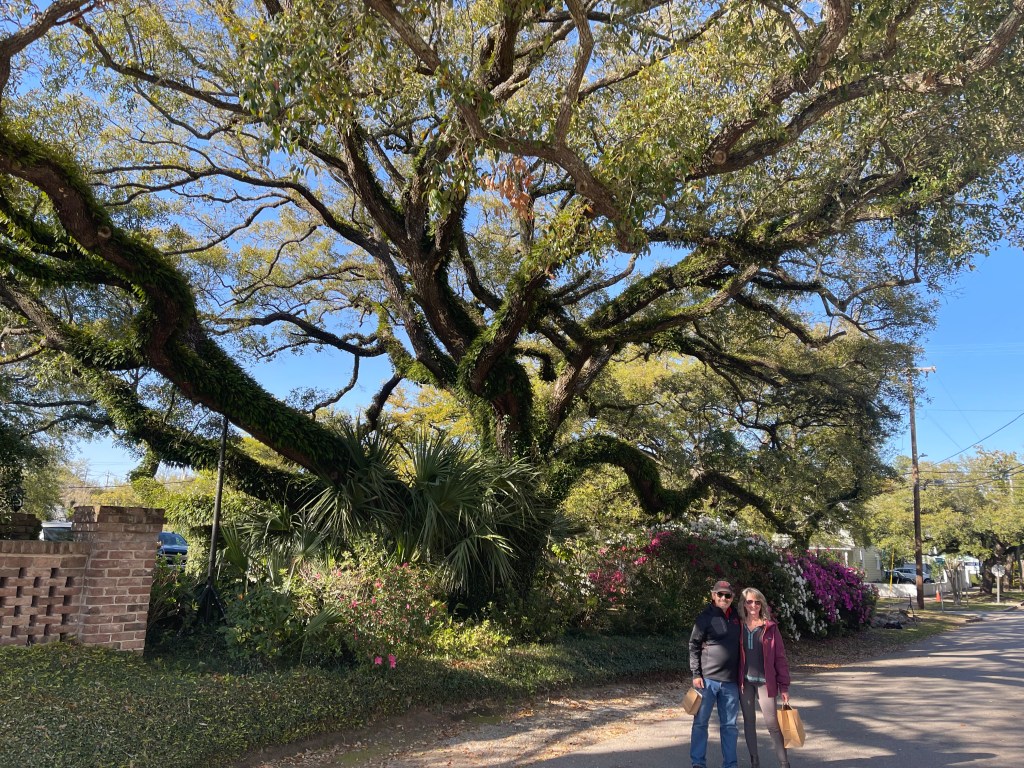
Dinner was memorable – excellent food with great friends enjoying conversation and some good laughs, at ourselves, our stories and our luck with the forecasted weather. Wind on the nose, followed by record cold, followed by wind on the nose, followed by a fierce gale. We plotted our courses back to Annapolis accordingly. We ended the evening on Eleanor playing a hand of cribbage – a storied card game that Michelle and I enjoy, which we felt obliged to inflict upon our hospitable hosts. Then a 9 pm bedtime to prepare for the 7 am shove-off to a new point B, with new memories and moments. Eleanor, bearing witness, gave us shelter and comfort as we anticipated the point Bs to come on our passage. We were not bringing Eleanor “home” as much as she was bringing us “home” to the things that mattered – good friends, sharing their journeys, with many kind-hearted souls along the way.
Kurt Karsten 3-29-22
-
Underway – Homeward Bound
by Jon
After four months at the Mega Dock in Charleston it was time to bring Eleanor home. Since bringing her south at Thanksgiving we hadn’t been able to visit Eleanor as much as we expected. Conflicts with work, family travel, and other commitments had clogged our schedules. We sadly had only one nice long weekend over New Year’s Eve to really enjoy Charleston, and not having even visited the boat in almost three months I used our little Cessna to fly down for the day two weeks ago with friends Mike Baldwin and Phil Buckley to deliver some parts and check her out for the six-hundred-mile voyage home.

Men in search of shrimp and grits In spite of sitting idle for many weeks, she was in good shape. No leaks. No visible problems. Just resting quietly waiting for us. After stowing the gear we brought down and finishing the few items on my work list I decided to fire up the engines. The port engine fired right up in less than two seconds and settled into her comforting calm rumble. The starboard engine turned over and cranked…and cranked…and cranked. I stopped trying. After a pause to rest the starter, I tried again. No joy. She wasn’t going to start, which was a new issue for me.
Diesel engines are pretty simple. To run they need clean fuel, clean air, rotation from the starter to build up compression, and BANG, the combustion in the cylinders gets things spinning and she runs. But this time starboard wasn’t going bang so what was missing? I opened the engine hatch and pulled out my little tool bag.
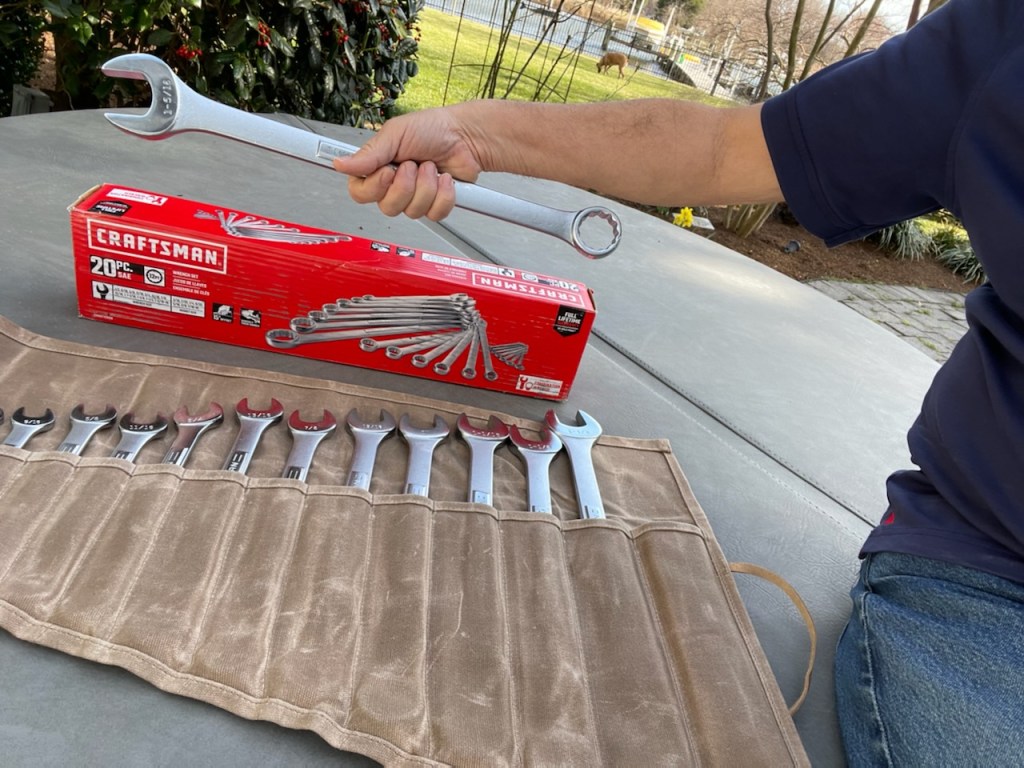
A man and his wrenches For my birthday I had asked Terese for a set of really big wrenches. Craftsman. 20 sizes all the way up to 1 5/15” and the entire set weighed in at over twelve pounds. The problem with having new tools is the desire to use them. Instead of starting with the obvious, I went right for the wrenches and started bleeding the fuel system. Loosening a bolt on the downstream side of the fuel filter I pushed on the pump and fuel trickled out, just as it should. Not the problem. I tightened everything back up and took two steps back. Go back to the basics, I thought. I climbed down into the engine compartment and went to the fuel manifold to check valve alignment. The starboard engine fuel valve was closed. Who the hell did that?
With the valve opened the starboard engine started right up. After warming both engines I decided to make sure the transmission worked. I put the engines into gear and back out one at a time. Mike and Phil were standing by the transom when I did it and yelled for me to look toward the stern. When the props spun, a huge layer of seaweed and oyster shells had flung off creating a dramatic mess. I wasn’t worried. I had a diver set to clean the bottom soon. Four months of sitting in the temperate South Carolina waters had overcome our tired bottom paint, but that wouldn’t slow us down for our cruise. After a failed search for shrimp and grits in town (note: don’t try to have lunch on a beautiful day in Charleston sans reservations) we climbed back into the Cessna and headed home.
Our crew for the voyage home, (Terese and our friends Kurt and Michelle) were set to fly in from Baltimore on Saturday the 26th, so I headed south a few days before to be sure everything was greased. I gave both engines a thorough going over, topping off fluids and lubricating moving parts. The incoming crew gave me an extensive grocery list and I did my best to fulfill all their requests at the Publix. I ran through a twenty-item pre-underway work list of minor tweaks and got us ready to get underway as soon as the crew hit the dock.
The forecast for our departure on Saturday was for wind. Lots of wind. It was going to start light out of the northwest, but with gusts doubling the velocity at times. Throughout the day it was going to keep rising with the forecast calling for 15-20 knots, with gusts to 31 by the afternoon. The sooner we could get underway the better.
While I waited for the crew, I set up our little pirate flag on the bow and noticed the prevailing winds were right down the narrow fairway where we were docked. The gusts came more from the south, which meant that when steady, it was straight on our bow which would help push us in the direction we needed to go to get out of here, but, and it was a big but, when a gust came it would push us to starboard, toward two boats moored directly astern of us. I did not want to find us bouncing off two million dollars-worth of yachts: a Flemming and a Hinckley.
The ideal time to get underway in Charleston is at slack water. The moment when the tide stops ebbing out, or flooding in, and there is no current in the basin. With tides going up and down more than five feet twice a day, there is a lot of water moving in and out of the river. We didn’t need to contend with current on top of wind. Slack water low, at the bottom of the tide cycle, would be at 10:04am, exactly the time the crew would be making their way from Charleston International. Getting off the dock smoothly depended largely on how quickly they could cab or Uber. When they texted that they were off the plane and on the road, I decided we’d try to make it.
I started singling up lines, taking off the extra moorings we’d put in place four our four-month wintering over, as I anxiously watched the pirate flag. The current had stopped moving but the wind was building. Ahead of us was a new 40-foot center console Intrepid, tender to a big yacht moored in the harbor. It’s triple 400 horsepower outboards gleamed at me. I was surrounded by opportunities to do millions of dollars in damages, along with the threat to our own Eleanor.
Finally, I saw the the crew walking briskly down the dock. Quick hellos aside they threw their luggage on board and went to work. Most of the lines came aboard quickly and with only a bow spring and stern line left, Kurt cast off the stern line to Michelle and climbed aboard.
I put the port engine ahead, kicking the stern out a little and moving forward away from the Flemming. Putting engines into and out of gear, I tried to twist the stern further out so we could back out.
But the wind wasn’t having it. It pushed the stern back in. Not enough power.
I goosed the throttle to twist harder and as the stern came out the bow went in. We were all wearing headsets so I was able to give Terese a quick request.
“Terese. I need you on the dock to hold the bow out.”
Terese hopped off the bow and dropped lightly onto the dock. She leaned hard into the bow and created a fulcrum point. I started another twist, port ahead, starboard back. The stern kicked out and Terese held the bow off the dock. I looked aft and it appeared we were getting far enough out to clear the Flemming. I goosed it a little more to give myself more clearance.
“Terese, back on board.”
She grabbed the rail and threw one leg on the boat, the other still dangling as she gave one last push off the dock before clambering back on board. With Terese safe, I put both engines astern and started backing out.
But that damn wind started a big gust, pushing us sideways toward the Flemming as fast as we were going backwards. Our starboard side was sliding right into the corner of her transom.
I revved the starboard engine to near full power and we started moving backwards faster, but now the bow swung toward the Flemming. I slowed the starboard and revved the port hard, the acceleration backwards increasing but now pulling the bow to port. With a lot of noise from our high revving engines we held the attention of everybody in the marina as we slid past the Flemming with at least a foot to spare.
We backed out of the fairway, stowed our fenders and dock lines and headed out for our first day northbound. The crew survived this first adventure with grace (Terese), competency (Kurt & Michelle), and luck (Jon).
-
“No One Can Make You Feel Inferior Without Your Consent” -Eleanor Roosevelt

Final sunrise in Charleston When you become obsessed with a project, not even knowing the goal, having no real vision of the tunnel or if there will be a light at the end, you know you’ve set upon a passion–a this will BE, sort of ongoing devotion. That’s how it’s been with Eleanor. Despite her moldy draperies, her failed wooden depressions and scabs, her dusty, rusty electronics, on that chilly October afternoon in Matthews, Virginia, it was love at first sight. We’ve poured ourselves into her. I have a few scars to prove it…. Eleanor and I both have. Where I have cracked skin around my thumb nail, she has a small gash in her wood where I slipped with the scraper. Where I have scars from chemical burns on the tops of my fingers, she has a few frozen varnish drips, forever hanging from her teak trim. Where the lines around my eyes have been over-soaked in sun, she’s peeling her paint on her weathered foredeck.
Eleanor is situated here in Charleston on the so-called “Mega-dock.” The dock itself is 1,530 feet long, counting only the water-facing pier and can accommodate boats as long as 455 feet.
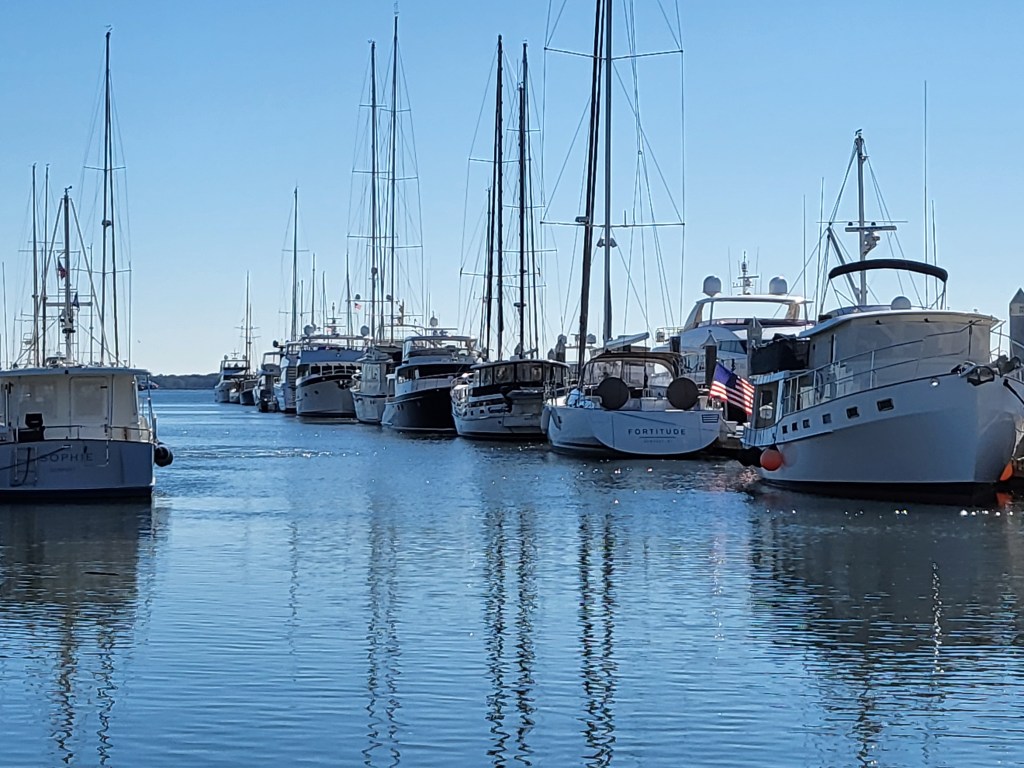
The Mega-dock hosts many mega yachts! She is nestled between a 60+ foot sage-colored sport fishing yacht whose captain sits in mahogany seats, above thick, luxuriously appointed, spotless fiberglass, and a triple-decked Azimut 50 fly. Across from us is Bonne Vie, a Nordhaven 62, and in front of her is Scorpio, 90 foot Hargrave. All of these vessels are worth two, three, maybe four million. Jon often jokes that we paid less for Eleanor than the taxes on our neighboring floating mansions.
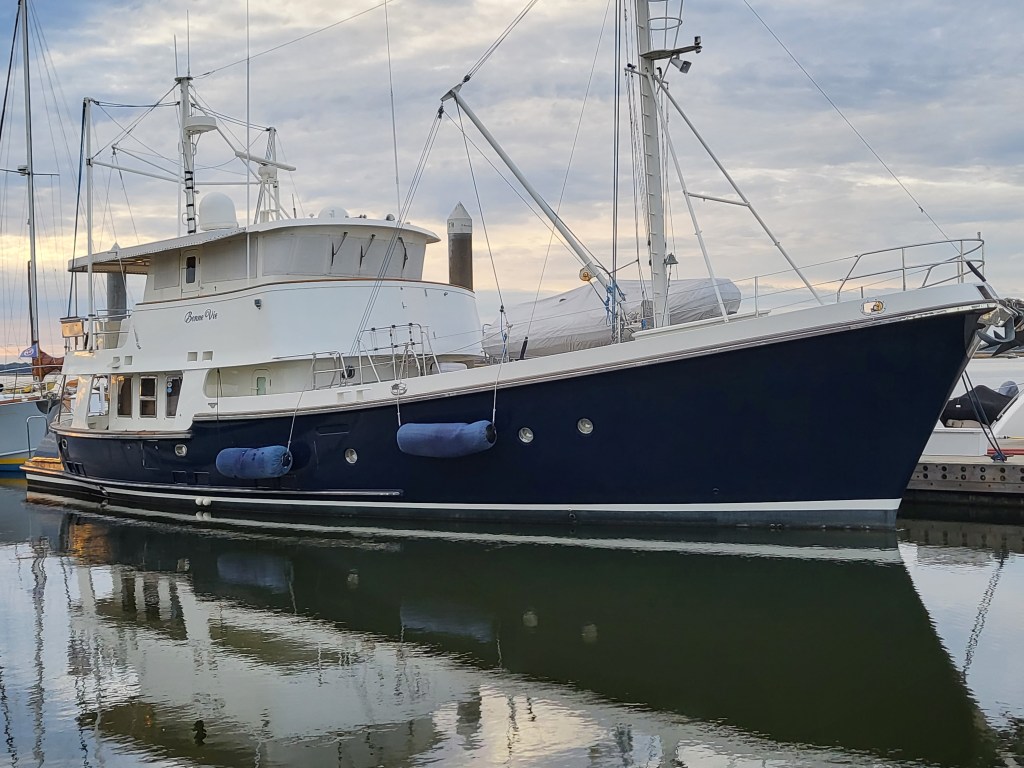
Bonne Vie, a Nordhaven ’62 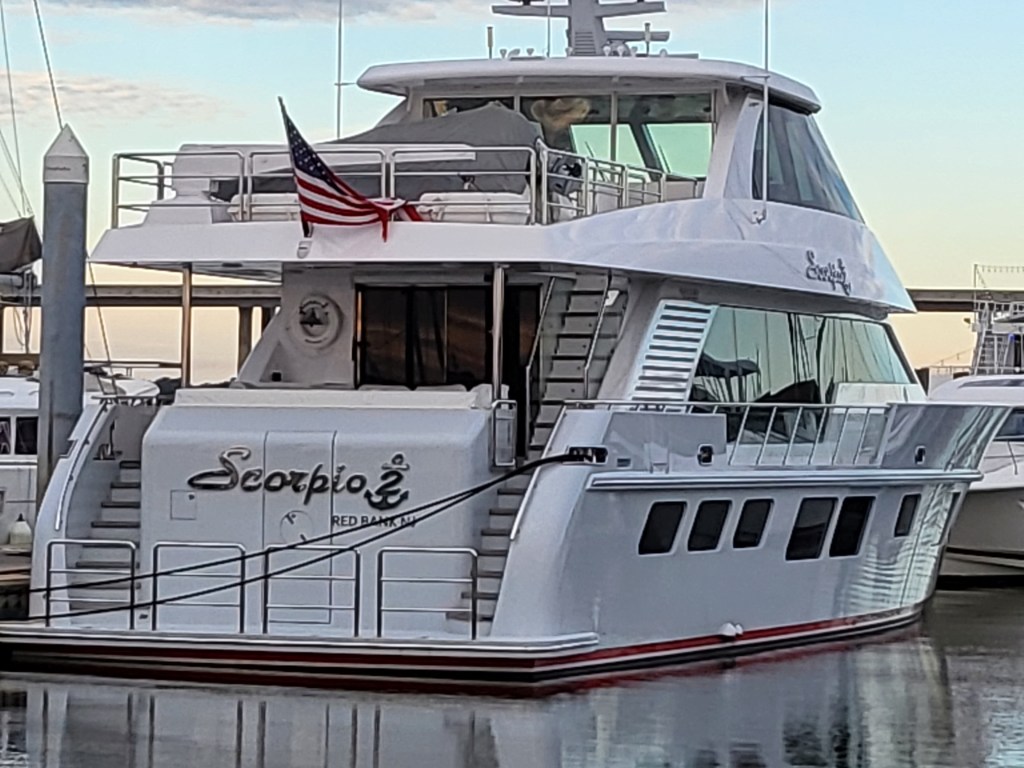
Scorpio, a 90-foot Hargrave Among them, though, rather then be dwarfed, Eleanor seems to stretch back her shoulders and stiffen her chest. Her lines rise proudly from the sea, having safely and surely transported her new family to port. She is a tough, badass broad, outshone only by her refurbished beauty, having seen some watery road and come back to outlive and out love them all. Like her namesake, she is sturdy and outspoken and long-serving.
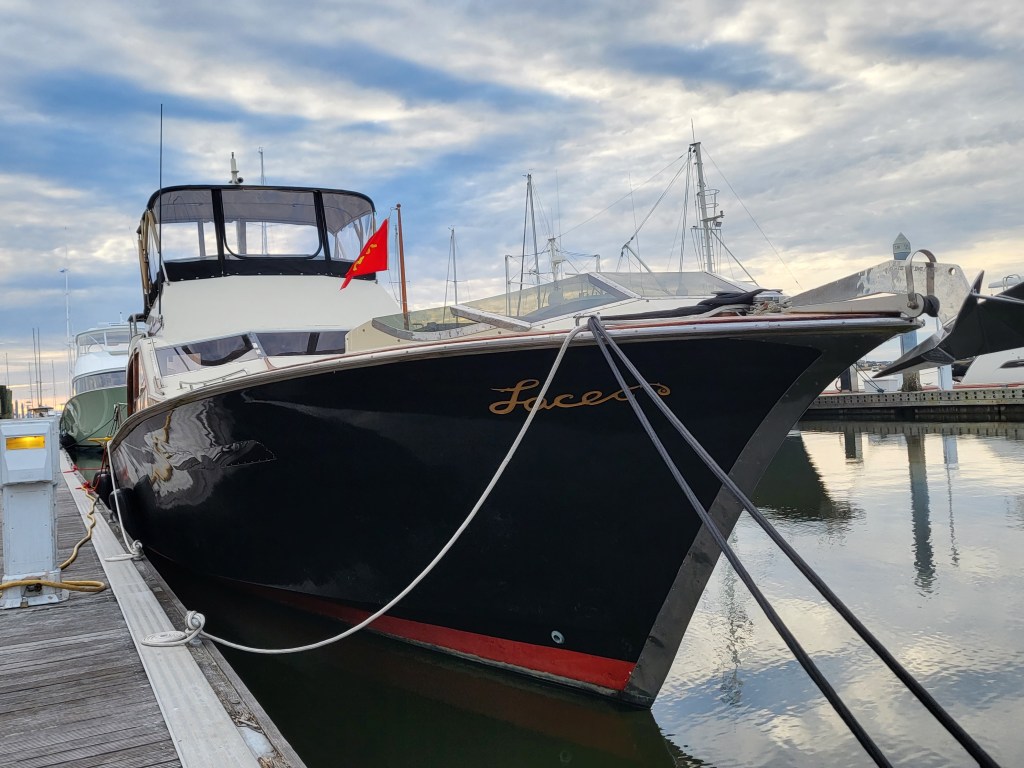
Eleanor the Badass Tonight we fly home to the Shady Side. We miss our girls and our home but there will be a certain vacancy there. What will we do not having to carve out several hours each day to toil aboard E? I suspect that time will be filled with things pushed into it so we can go visit her often in Charleston. Meantime, Eleanor will fill her space and keep herself steady, ready for the next sea-splitting adventure.

Thank you, Captain and crew for a fabulous voyage! With love, from your Cruise Director -
Twenty-four years later, what’s different?
(From Jon’s perspective)
In 1997 I went down the Intracoastal Waterway with my father, Russell, and brother, Andrew in another project boat. That journey at the dawn of the Internet era started out as daily email updates to friends, and ultimately became a book. Adventures in the Ditch earned modest success with an Eric Hoffer award as a ‘notable memoir’ and has sold over 1,100 copies in the years it has been available on Amazon.com. One of the readers of this blog, my well-known author friend Susan Moger, posed the question, “What’s changed since Adventures?” The simple answer is almost everything.


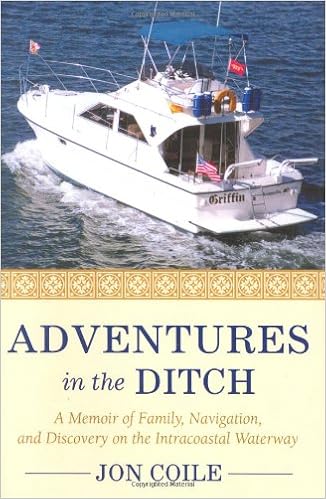
But let’s start with what hadn’t changed much. The boat we used, for both adventures, was a ‘project boat.’ Both good boats that had seen better days in their past and needed some attention to bring them back into cruising shape. Griffin was a 1985 Fairline Corniche 31. A fiberglass flybridge with twin diesels. Eleanor is a 1981 Cheoy Lee Midnight Lace 52, also a fiberglass flybridge with twin diesels. Both are fairly simple in boat terms in that they don’t have many complicated systems. No autopilot. No water maker. One small generator to power the air-conditioning systems and provide multiple charging points for our personal electronics. And both took a year to get everything working up to the level required to make a thousand-mile trip. Terese took on the job of esthetics onboard Eleanor, reupholstering the salon furniture and putting ten coats of varnish on our extensive exterior teak. So, I will say we look better this time compared to the utilitarian Griffin. We lost count of how many people we saw taking pictures of Eleanor from their boats or the shoreline, which was fun validation of the work we put in, and of course Eleanor’s beautiful and unique lines.
Griffin had her original 1985 vintage Volvo diesels when we made the trip back in 1997. Back then engines smoked and smelled. Every day we had to wash the transom to get the soot off after a day running on the ICW. Eleanor was repowered in 2002 with the then current state of the art in Yanmar diesels. No soot. No smell. I’ve heard that diesel engines have come even further in the two decades since our Yanmars came out, but we are content with what we have.
Another thing that hasn’t changed are the shifting sandbars on the ICW. The Intracoastal is basically a series of rivers, sounds, bays, and creeks, connected with the occasional canal dug out of the mud or rocks to connect the natural waterways. Built back in the 1930s as a way for tugs and barges to move up and down the coast without regard to North Atlantic weather, the ongoing and perpetual challenge is keeping these various waterways dredged to at least six feet. Where inlets from the Atlantic intersect the ICW, silt starts piling up and can block the waterway. Dredging equipment moves up and down the ICW attacking the sandbar of the day.
But here is the positive change. Thanks to the advancement in electronics, and rapid dissemination of information through the internet, it is easy to have near-real-time situational awareness of the locations of these shifting shoals. In the narrow channels of the ICW, the U.S. Army Corps of Engineers run a survey boat with a side-scanning sonar taking a detailed picture of the bottom. Then using color coding to show different water depths, from green through yellow to orange and ultimately red, it is easy to understand where the danger lies. Broadcast to the internet, and then downloaded to an iPad connected to a small GPS receiver, we can see exactly where Eleanor is in relation to the shoals. With such situational awareness we don’t even need to slow from our 21-mph cruising speed to slalom through most areas. Running aground used to be fairly common on the ICW, but now you have to be very unlucky, or inattentive, to touch the bottom. Southbound we did not touch this time, while Griffin hit the bottom at least once both south and northbound.

When I started writing Adventures in the Ditch in 1997 there was only one book in print that covered the Intracoastal Waterway in memoir format. The competition, Honey, Let’s Get a Boat was actually the first of the Great Loop books that started with a northbound trip up the ICW, but then kept going up the Hudson to the Great Lakes, over to Chicago, down the Mississippi to the Gulf and around Florida back to the starting point. Clearly a more adventurous journey than just the ICW, but for those who wanted to know what to expect on the ICW portion of the trip, Honey… and Adventures… were the only two choices for several years.
Flash forward to today, there are countless blogs, Facebook groups, YouTube videos, and channels devoted to sharing the daily adventures on the ICW. Pick your type of boat, from derelict sailboat to million-dollar motor yacht and there is a blog or video channel where you can follow someone living your dream. There are Facebook sites devoted specifically to ICW navigation. Others devoted to the trawler cruising lifestyle. Still others that are focused on advice on repairs, improvements, and product recommendations. Even young families that have sold everything and moved aboard to explore the world, starting with the Atlantic coast of America. And then there is Bobby, who has an ever-changing crew of young lovelies who frolic for his selfie video camera on his YouTube channel, “Sailing Doodles.” You name it, you can find it on the internet, continuously updated.
The final thing that seemed different is the quantity and quality of boats on the water. We are amazed at the size and grandeur of the yachts we’ve encountered this time around. There were always large yachts, but it seems the average boat we encounter is bigger and newer now, than what we remember from twenty-four years ago. This is kind of interesting since in the intervening years we’ve had the Dotcom bust, the Great Recession, and the recent Pandemic. Still, the country seems richer than it was a quarter century ago.
So, Susan, no Adventure in the Ditch, Volume II. This little blog is it. As they say, “no market for it.”
Thanks to the crew who helped with the preparation for the journey as well as the onboard crew for the voyage. Jenn was our human autopilot, taking frequent extended turns at the helm. Craig was our CHENG – Chief Engineer — handling pre-underway engine checks every morning and coordinating the shift from shore power to ships power, and back again every day, plus numerous jobs during the year-long renovation of Eleanor. Terese managed all aspects of the voyage, from taking her turns at the helm, including driving Eleanor out into the Atlantic Ocean for the first time, to selecting marinas and restaurants and keeping us all fed and happy. More than a First Mate, she was active as Co-Captain and Cruise Director.
Overall, it was a fun and successful mini adventure!
-
Eleanor Arrives
Eleanor carried us safely to her new temporary home at the “mega dock” in Charleston, SC. We arrived around 2:30 pm on Thanksgiving day, thankful for the amazing journey. She will now stand out in her unique way among the boring mega yachts 🙂

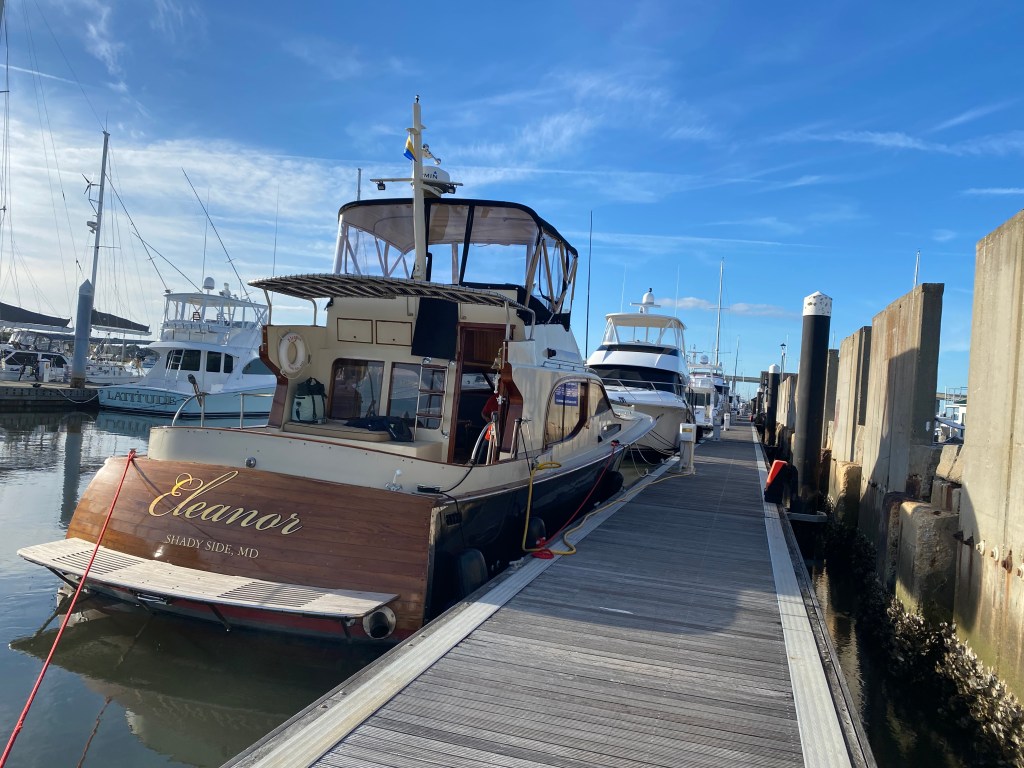
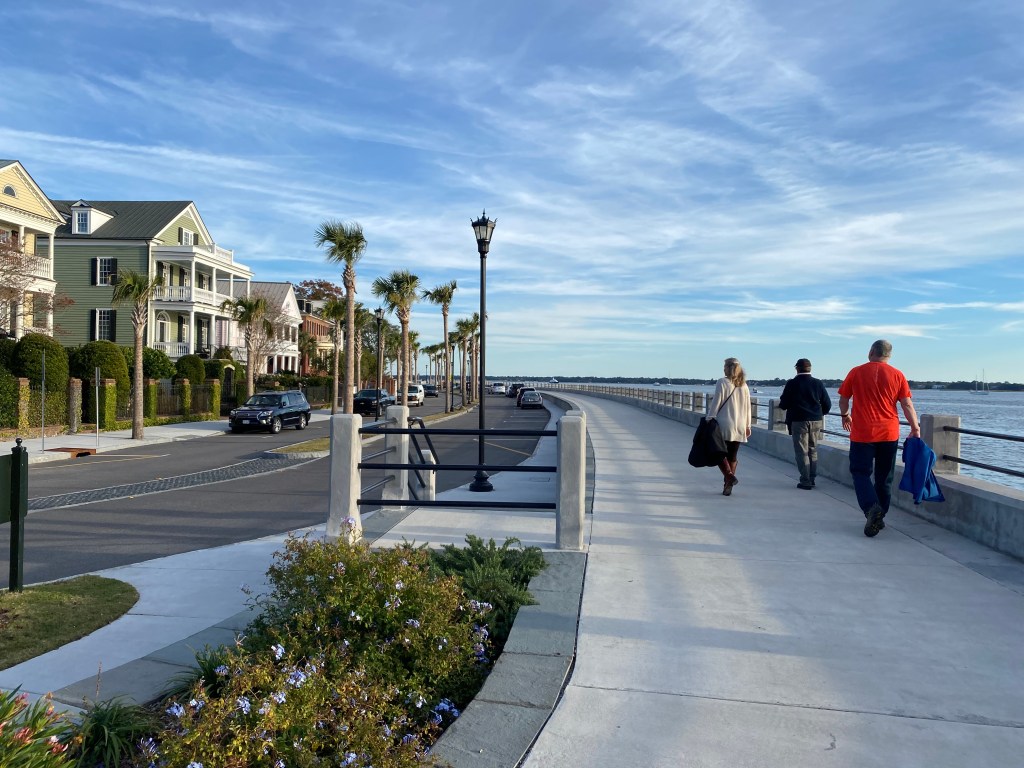
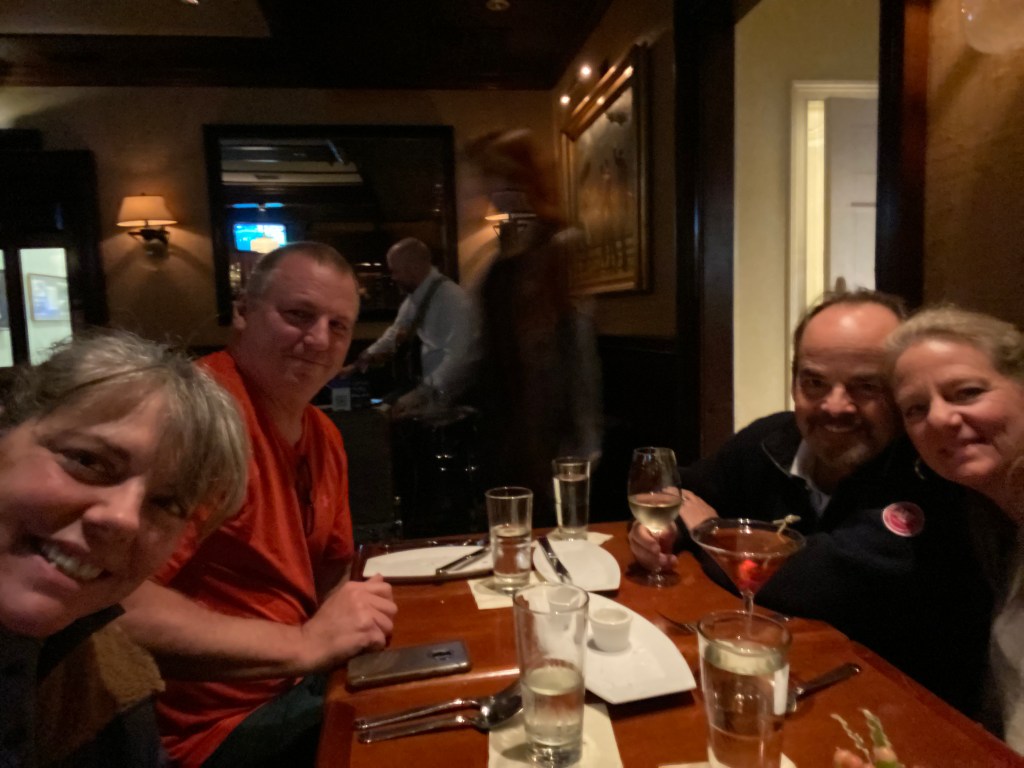
After Jon expertly parallel parked her and we made sure she was moored appropriately,, we went for a walk along the Battery to stretch our sea legs. We had an amazing dinner at High Cotton. It wasn’t exactly like a family Thanksgiving, but it involved turkey, Brussels sprouts, and shrimp & grits. We also enjoyed live music and celebrated how lucky we are to live this life! Cheers to all!

 Aboard Eleanor